16 October 2026
Pärnu in winter: what stays open, what to do, and whether a quiet weekend is worth it
Most guides to Pärnu stop at the beach. The honest version for November to March starts with a sauna, ends with the river promenade at dusk, and admits that two of the things you came for will be closed. Anyone searching for things to do in Pärnu in winter is really asking three smaller questions at once: what stays open, what is the town without the summer noise, and is the journey from Tallinn worth it when the water temperature hovers around freezing. The next two sections answer all of them.
Table of contents
- Key takeaways
- What Pärnu is actually like in winter — weather, light, and who is around
- What's open in Pärnu off-season (and what isn't): restaurants, spas, the beach promenade
- Is the beach still worth a walk in November, December, January, or February?
- Where to eat: which Pärnu's restaurants stay open all year, and which close until May
- Day trips from Pärnu in winter: Soomaa, Kihnu, and Parnu County
- Indoor things to do in Pärnu when it rains or freezes
- Is a Pärnu winter weekend actually worth it? A short verdict
- Sources
Key takeaways
- Pärnu in winter is a quieter, smaller town — roughly 40,000 residents instead of the summer crowd, with temperatures around −4°C to +2°C and only six to seven hours of daylight between November and February.
- The beach promenade, the old town, the spa hotels, and a handful of year-round restaurants stay open; the big water-parks and most beachside terraces close between October and May.
- A sauna-led weekend is realistic: most hotel saunas run on shared hours, and private slots are easy to book outside summer.
- Day trips to Soomaa National Park and the coastal villages still work in winter, but Kihnu island ferries run on a reduced winter timetable.
- For Nordic and British travellers, Pärnu in winter is a calmer, cheaper alternative to Tallinn, not a replacement for the summer beach trip.
What Pärnu is actually like in winter — weather, light, and who is around
Pärnu in November, December, January, and February is a different town from the one that fills the beach in July. Daytime temperatures sit between about −4°C and +2°C, the sea is around 2–4°C, and snow is common but rarely heavy enough to block roads for more than a day. Daylight is short: sunrise around 9 a.m. and sunset around 4 p.m. in December, stretching to about 7 a.m. and 5 p.m. by late February.
The population feels it too. Pärnu has roughly 40,000 residents year-round, and the summer visitors who triple that figure in July are mostly gone. The streets around the promenade, the bus station, and the market are noticeably calmer, English is still spoken in restaurants and hotels, and weekend foot traffic on Ranna puiestee (the beach road) drops to a tenth of summer levels.
That quietness is the reason people come. Off-season travel in Pärnu is built around slow days: one long walk, one long meal, and one long sauna — not three museums and a cocktail bar.
What's open in Pärnu off-season (and what isn't): restaurants, spas, the beach promenade
The honest map of Pärnu in the cold months looks like this.
Open all year. The beach promenade and the riverside path are public and walkable in every season. Most year-round restaurants in the old town keep their kitchens going through winter (covered in detail below). Spa hotels with reduced annual opening schedules continue to run their saunas and pools, often on shared hours. The Pärnu Market Hall near the bus station is open daily.
Partially open. Beachside terraces close from roughly October to May. Most summer-only cafés shut for the season, then reopen in stages from late April. Daylight hours for some attractions are shorter.
Closed. The big water parks and aqua centres are largely a summer product. Outdoor water sports rentals shut for the winter. Some coastal cafés and most beach kiosks are dark from November to April.
For practical layout — where the promenade meets the old town, where the bus station sits relative to the beach, and where a transfer from Tallinn would drop you — the location page is the cleanest reference. Anyone coming from the capital will also want the tallinn to parnu without car guide before booking.
Is the beach still worth a walk in November, December, January, or February?
The beach in winter is the same beach, dressed differently. The white sand is still there, the promenade is still wide enough for two to walk side by side, and the sea is still doing what it does — but there are no swimmers, no sunloungers, and almost no one on the path. For a couple who likes long walks and quiet light, that is the point.
A typical winter walk runs from the Pärnu Beach near the SUP park, north along Ranna puiestee to the river mouth, then back along the riverside promenade into the old town. Allow 60–90 minutes at an unhurried pace, longer if the wind is up. Photography is good at low sun in late February, when the light stretches sideways across the dunes.
Two practical things to know. First, the wind off the Baltic is colder than the thermometer suggests — a −3°C morning on the sand can feel closer to −8°C once you are past the sea wall. Second, dogs are allowed on the beach in winter, and you will see them; if you do not want to meet them, stay closer to the town side of the promenade. For Nordic visitors used to cold, this is gentle weather; for anyone else, it is the kind of walk to do once a day, not three times.
Where to eat: which Pärnu's restaurants stay open all year, and which close until May
Pärnu has a habit of looking fully open in summer and looking half-closed in February. The pattern is consistent enough to be useful.
Year-round places sit mostly in the old town and along Nikolai or Lai streets. Anaerobic food halls and small bistros that pivoted away from a summer tourist menu keep their kitchens running, often with a tighter winter menu. Cafés with a regular local following — places Estonian families eat in on a Saturday in January — are the safest bets.
Seasonal closures affect almost everything with "beach" or "terrace" in the description. Most close between mid-October and mid-November and reopen in stages from late April through May. A few pop-up only on mild winter weekends, so it pays to check the day's opening times before walking over.
Practical winter eating rules. Book ahead for Saturday dinner in the old town, even in January — many places run reduced seating. Lunch is usually the easy meal of the day, with shorter queues. For a couple weighing a quiet winter weekend against a summer trip, this is the difference that defines the weekend: dinners should be planned, lunches can be improvised.
Day trips from Pärnu in winter: Soomaa, Kihnu, and Parnu County
The county around Pärnu is one of the quieter parts of Estonia, and winter softens it further. Three day trips work in the cold months; one needs a check on the timetable.
Soomaa National Park is the easiest. The "fifth season" floods of spring are a separate trip; in winter the park is frozen bog, pine forest, and the famous beaver dams. About 90 minutes from Pärnu by car, with marked trails that hold their snow cover better than the coast. Cross-country skis can be hired near the park entrance on winter weekends.
The coastal county. Drive south along the coast through the villages of Häädemeeste and Kabli. The light on the dunes is the draw, and the small museums in the villages are open year-round on reduced winter hours. A full day, slow pace, and a thermos in the car.
Kihnu island is the one to verify. The ferry from Munaltee port (a smaller port nearby) runs on a winter timetable that drops to a handful of crossings a week, and ice can cancel sailings in the coldest weeks. Check the operator's schedule the day before and treat it as a weather-dependent trip.
Pärnu County more broadly rewards a car and a low bar for the day's plan. None of these need a guide — for anyone who has driven a winter road in the Nordics, these are easier than they sound.
Indoor things to do in Pärnu when it rains or freezes
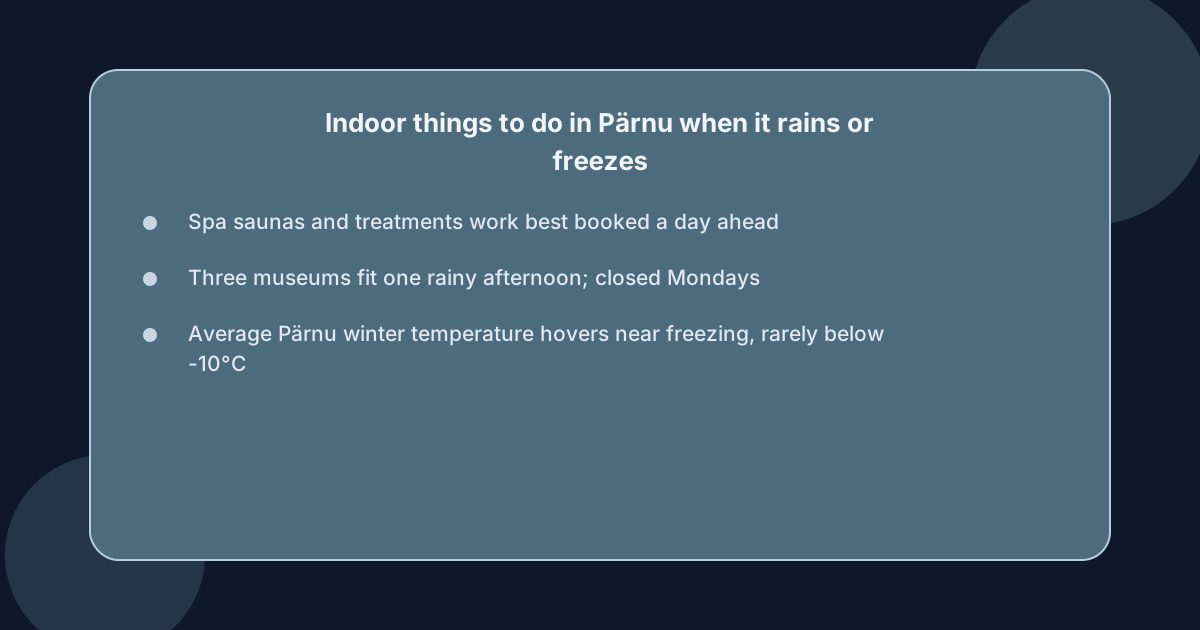 Rain is more common than heavy snow in Pärnu's winter, and the wind off the sea means it can feel colder than the thermometer reads. The good news is that Pärnu is small enough that an indoor day can be planned in three short moves.
Sauna, steam room, and a treatment is the obvious choice and the reason most people come. Spa hotels with reduced annual opening schedules run their saunas on shared hours, with a private slot bookable outside those hours. Massages are usually 60 or 90 minutes and easier to book a day ahead than on the day. The two-room layout — a small hotel sauna plus one treatment room — is typical of the smaller properties and is usually less busy on a January Wednesday than on a July Saturday.
Museums and galleries. Pärnu Museum, the Koidula Museum, and the photography galleries in the old town keep winter hours, usually closed on Mondays. Allow 90 minutes per museum; the combined total fits into a single rainy afternoon.
A long lunch and a bookshop. Pärnu's bookshops are year-round, the cafés that serve them are year-round, and the combination is the right pace for a wet February day.
For a fuller list of what to do on a grey day, including the cafés, galleries and covered markets that stay open, the things to do in p rnu when it rains guide is the most useful starting point.
Is a Pärnu winter weekend actually worth it? A short verdict
For a Nordic or British couple weighing a winter weekend in Pärnu against staying home or going to Tallinn, the honest verdict is yes — with the right expectations. Pärnu in winter is not the summer trip with colder weather. It is a quieter, smaller, slower town where the sauna matters more than the beach, the restaurant matters more than the bar, and the light at 4 p.m. matters more than the temperature at noon. If that sounds like the right trade, the weekend works. If it sounds like a downgrade from the summer trip, wait until May.
For most of the things this kind of trip actually asks of a hotel — a sauna on shared hours, a quiet room, a person to answer the email — a small, personally run property is a better fit than a large spa resort built for July. The wellness page of the hotel two minutes from the sand is a reasonable example of what that looks like in Pärnu: a single sauna and steam room, shared morning and evening hours, and two treatment rooms on the rota. It is not the right fit for anyone after a big resort spa complex or a thermal pool circuit — for that, a larger property is the honest answer.